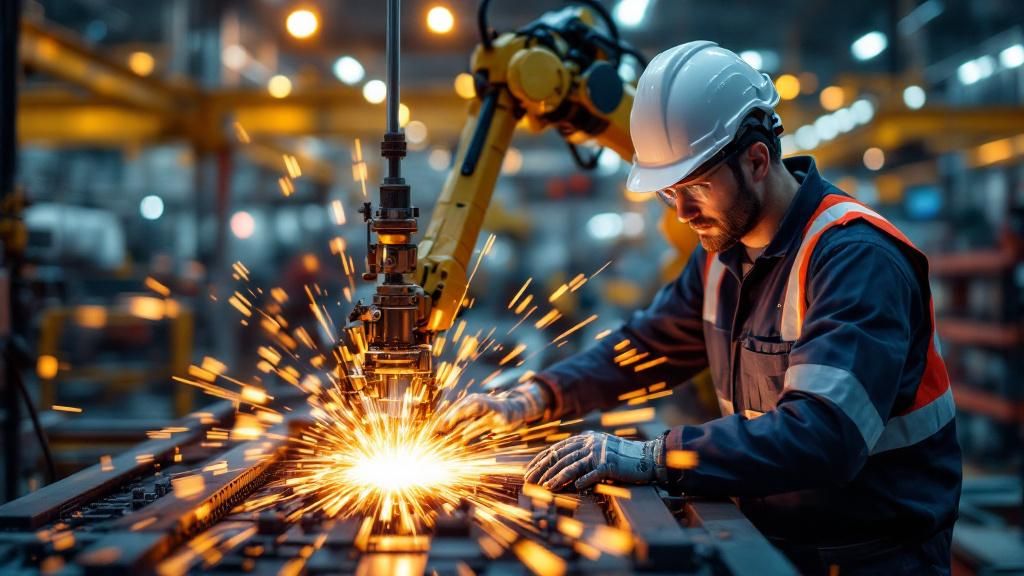
The UK manufacturing landscape is witnessing an remarkable transformation as industry leaders allocate record-breaking investments in cutting-edge automation technology and broad-based employee development schemes. This deliberate repositioning underscores manufacturers’ determination to boost operational efficiency, maintain their competitive edge, and secure their economic future. Our analysis shows the substantial financial commitments propelling this manufacturing transformation, examines the advanced systems transforming factory floors, and investigates how businesses are equipping their workforce for emerging challenges. Discover what this funding momentum means for British manufacturing’s trajectory.
Growth Surge in Automation Solutions
The UK production sector has seen an extraordinary financial commitment towards automated systems, with investments reaching unprecedented levels in recent years. Leading producers across automotive, aerospace, and electronics markets are investing considerable resources towards robotic systems, artificial intelligence, and advanced manufacturing solutions. This capital boost indicates manufacturer confidence in automation’s ability to enhance operational efficiency, reduce production costs, and improve product quality. The magnitude of this dedication highlights manufacturers’ recognition that technological innovation is essential for maintaining competitive advantage in an increasingly globalised marketplace.
Industry experts ascribe this investment momentum to several converging factors, such as post-pandemic logistics review, escalating wage expenses, and the critical requirement for enhanced production flexibility. Companies are focusing on automation technologies that provide adaptability and growth capacity, allowing rapid adaptation to variable consumer requirements. Investment data reveal that manufacturers are going well beyond simply modernising manual procedures but radically transforming manufacturing approaches. This planned method guarantees that British manufacturing stays at the vanguard of industrial innovation, positioning the sector for enduring development and enhanced resilience against future economic uncertainties.
Strategic Workforce Development Initiatives
Acknowledging that technological advancement alone cannot drive success, UK manufacturers are investing substantially in comprehensive workforce development programmes. These initiatives represent a core transformation in how the industry values and nurtures human capital. By pairing automation deployment with rigorous upskilling initiatives, manufacturers are guaranteeing their workforce can effectively operate, maintain, and optimise new technologies. This holistic approach tackles capability shortfalls whilst fostering staff morale and participation in an rapidly mechanised environment.
Skills Training Programmes
Leading manufacturers have created bespoke training academies and apprenticeship schemes intended to provide workers with vital technical and digital capabilities. These initiatives encompass robotics management, analytical data work, cyber security protection, and complex programming frameworks. Investment in instructor-led and online learning platforms ensures accessibility across all workforce levels. Companies are partnering with learning organisations to deliver certifications recognised across the industry, improving career development potential and employee retention rates significantly.
The financial outlay to skills training surpasses onboarding phase, with companies establishing continuous professional development programmes. Workers gain access to consistent training options to adapt to advancing digital environments and new sector standards. Many employers make available tuition reimbursement, mentoring schemes, and study leave for additional study. This continuous dedication demonstrates manufacturers’ focus on creating long-term career pathways and building a environment of ongoing education across their workforce.
Collaboration with Learning Establishments
UK producers are establishing collaborative relationships with universities and higher education institutions to align curriculum development with industry requirements. These collaborations ensure graduates possess hands-on abilities immediately applicable to contemporary production settings. Joint ventures include course development, visiting lectures, lab facilities, and resource supply. By engaging directly with academic organisations, manufacturers shape the flow of talent entering the sector, tackling foreseen capability gaps in advance.
Additionally, manufacturers support research initiatives and innovation centres within universities, encouraging knowledge exchange and technological progress. Double-degree programmes and industrial placements offer students with valuable hands-on experience whilst giving companies early access to new talent. These working relationships consolidate the UK’s status as a worldwide manufacturing centre, ensuring ongoing competitiveness and presenting Britain as an desirable location for cutting-edge manufacturing investment and skilled workforce development.
Economic Impact and Future Outlook
The record funding for automation and skills training is forecast to generate substantial economic benefits across the UK manufacturing sector. Sector specialists anticipate productivity gains of up to 25% over the next three years, leading to higher production and improved competitiveness in international markets. These developments are anticipated to generate approximately 15,000 new skilled jobs in manufacturing whilst bolstering Britain’s role as a technology-led manufacturing centre. The cascading impact of this capital injection will likely stimulate growth throughout distribution networks and complementary sectors.
Long-term outlooks for UK manufacturing appear decidedly encouraging as businesses position themselves at the vanguard of Industry 4.0 adoption. Companies investing in automation today are positioning themselves to seize new market possibilities and respond swiftly to shifting market requirements. The combination of artificial intelligence, robotics, and cutting-edge analytics promises to unleash transformative possibilities formerly limited by labour availability and practical restrictions. Future-focused manufacturers recognise that sustained competitiveness depends upon continuous technological advancement and employee skill enhancement.
Looking forward, the drive created through current investment trends indicates a significant restructuring of UK manufacturing’s economic impact. Government support via skills investment and commercial incentives will probably speed up adoption across smaller businesses. As automated systems advance and workforce skills grow, UK manufacturers are set to reclaim market share from overseas competitors. This transformation embodies not simply industrial modernisation but a strategic reorientation of the manufacturing sector as a cornerstone of Britain’s forthcoming economic prosperity and technological leadership.
